The case for Autopilot · sourced from Chicago FOIA data
$100 in late fees. $99 for Autopilot.
The average Chicago driver who gets a ticket in a year is billed $100 in late fees alone — on top of the original fines. Autopilot's mail-in contest service freezes the late-fee clock the moment a ticket lands. That one feature, by itself, roughly pays for the whole product — and it's the smallest piece of what you get.
Stack on automatic ticket contesting, city sticker and license plate auto-renewal, and our mobile app's coverage of 9 of the top 10 Chicago ticket types — and the math becomes a joke. Here's all of it, with every number sourced.
How we got to $100
The City of Chicago is in the late-fee business. A parking ticket starts at face value — $60 for street cleaning, $50 for an expired meter outside the Loop, $100 for a red-light camera — but if you don't pay or contest within 25 days, the City mails a Violation Notice and adds a late penalty. For most tickets the fine doubles. For higher-value violations the total is capped at $250 by ordinance (so a $200 city sticker ticket becomes $250, not $400). Keep ignoring the notices and the City enters a default determination of liability, after which it goes to collections and can suspend your driver's license.
We pulled every parking, red-light, and speed-camera ticket issued to a Chicago-registered vehicle over 2022–24 from the City's own FOIA data and asked one question: how much of what drivers were billed was late-fee penalty, not the original fine?
-- foia.db, tickets table (35.7M rows, 2018-2025)
-- Chicago-registered plates (606xx ZIP), averaged over the
-- three matured years 2022-2024:
SELECT
  -- What the City actually billed: payments made + balance owed
  SUM(total_payments + current_amount_due) / 1e6   AS billed_M,

  -- Late penalty = the part billed ABOVE the original fine
  SUM(MAX(0, (total_payments + current_amount_due)
             - fine_level1)) / 1e6                 AS late_fees_M
FROM tickets
WHERE substr(issue_datetime, instr(issue_datetime,' ')-4, 4)
        IN ('2022','2023','2024')
  AND zipcode LIKE '606%';   -- Chicago-registered plates

-- Per-year average result:
-- billed_M:     $263M   (face + late)
-- late_fees_M:  $88M    <-- the late-fee tax
-- face_fines:   $175M   (billed - late)

-- NOTE: we do NOT sum fine_level2 (the "doubled" column). That is a
-- fixed price schedule printed on every ticket, including the ones
-- dismissed or paid on time, so it overstates what was charged.
Chicago drivers were billed $87.9M in late-fee penalties a year (2022–24 average). Not fines — penalties on top offines, triggered when the City mails a Violation Notice past the 25-day window and the ticket still isn't paid or contested.
We then needed the right denominator: not "all Chicago drivers" (which would dilute the number across people who never got a ticket), but "Chicago drivers who actually got at least one ticket." For that we filed a separate FOIA — F136386-041726 — asking the Department of Finance for the count of distinct license plates registered to a Chicago address that received at least one ticket in a year. The answer: 883,240.
Chicago late fees billed / yr   =  $87,900,000   (2022–24 avg)
Chicago plates ticketed / yr    =       883,240
──────────────────────────────────────────────
Late fees per ticketed driver   =         $99.52   ≈  $100
$100 a year per ticketed Chicago driver, in late-fee penalties alone. That number is real, derived from public records, and reproducible against the same database any researcher can request.
And it's the right number to use. 68.5% of all Chicago-registered vehicles — roughly 7 in 10 — received at least one ticket in a year (883,240 ÷ 1,289,632). Anyone who would consider buying ticket-protection software is already in the ticketed cohort — that's why they're shopping. So that's the denominator that matters.
Now stack the rest of what Autopilot does
The $100 in late fees is just one piece. Here's what else is in the box, layered on top — split into what we run automatically for you (Layers 1–3) and what we help you avoid (Layer 4).
🟢 AUTOMATIC — Layers 1, 2, 3
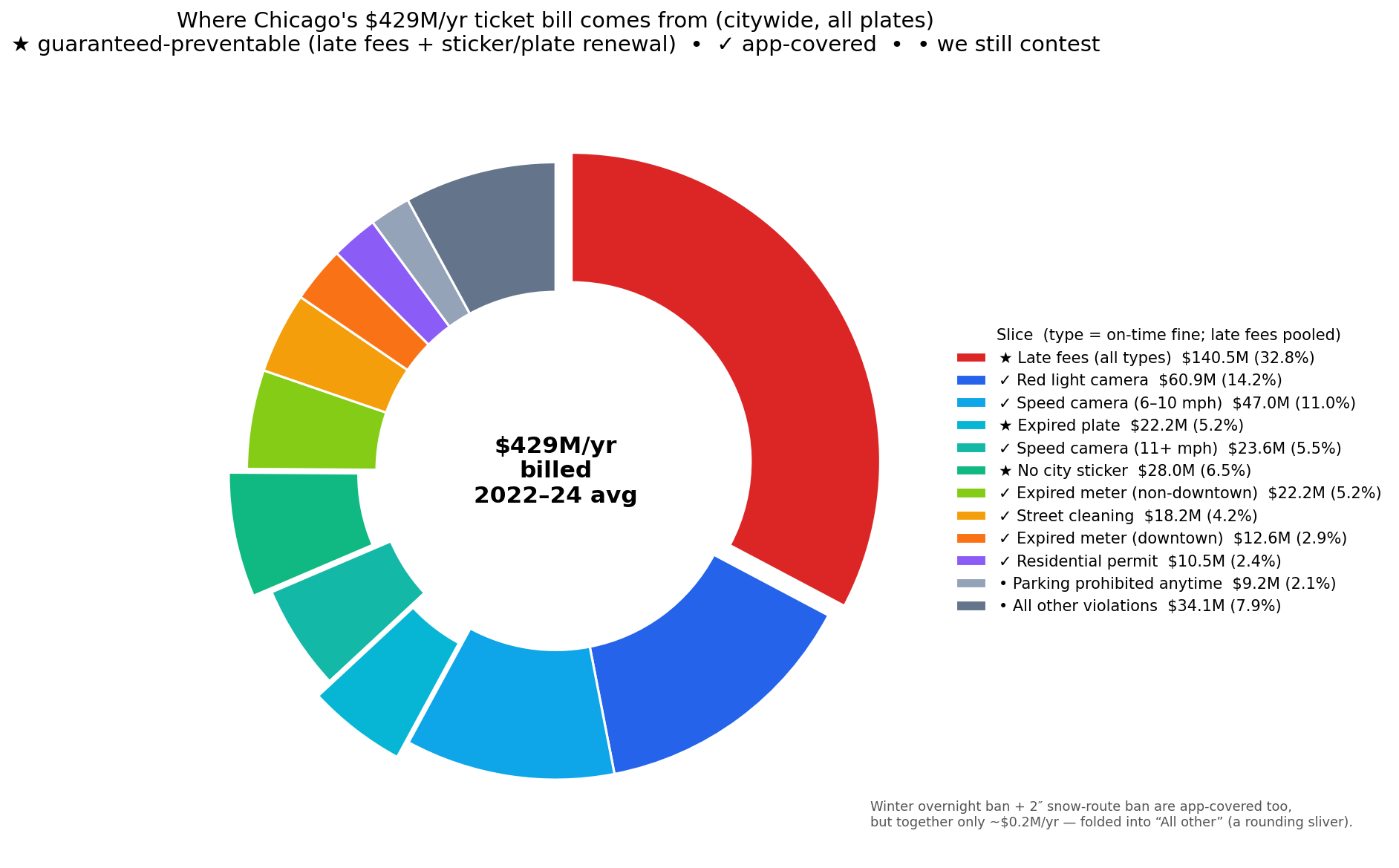
These layers don't depend on you reacting to anything. We wipe out every late fee — $140M (33%) of the $429M Chicago bills drivers a year — paid before it doubles or frozen the moment we file a contest. And we auto-file a mail contest on every ticket, including your city-sticker and plate tickets (among the most-dismissed categories citywide). Our Better-Off Guarantee backs the whole year: you pay the face value of the ticket, we pay the late penalty, boot, tow, and storage.
Late-fee protection on every ticket
Worth ~$100/year for the average ticketed Chicago driver
The moment you forward a ticket to Autopilot — or we pull it from the City's portal automatically — we file a mail-in contest within 21 days. That filing freezes the late-fee clock. The City cannot double the fine while a contest is pending. Win or lose, the penalty doesn't accrue.
For the 68.5% of Chicago drivers who get ticketed in a given year, this feature alone is worth, on average, $100/year — derived above from real FOIA data.
Automatic contesting — you don't lift a finger
93% of tickets go uncontested. The ones contested by mail win 59% of the time.
Filing a contest in Chicago means writing a defense letter, mailing it to the City's adjudication office, and either showing up to a hearing or requesting a decision on the documents. 93% of Chicago tickets are never contested — drivers just pay or let them slide into late-fee territory. It's not because the tickets are good. It's because the process is hostile.
When Chicago drivers actually do mail in a contest, they win — dismissed entirely — 59% of the time. That's the trailing 2023–2025 win rate for the mail-in path, computed from 287,532 decided contests in the hearings table of our FOIA database.
Autopilot does the contest for you. No letter to write. No certified-mail trip. No hearing to attend — we elect the mail-decision option on every contest, so the hearing happens on paper. You get a decision in 6–10 weeks. If we win, the ticket is gone. If we lose, you've still avoided every cent of late-fee penalty because the clock was frozen the whole time.
City sticker & license plate renewal — we renew both for you
Skip the sticker-and-plate scramble — we attempt both renewals for you
Every car registered in Chicago needs two annual renewals: the city sticker from the City Clerk, and the license plate registration sticker from the Illinois Secretary of State. Miss either and the City writes a ticket — over and over, day after day, until you fix it.
City sticker: the fine is $200 per ticket. In 2025 the City issued 160,333 city-sticker tickets to Chicago-registered plates, billing them $35.9M (face + late fees).
License plate / expired registration: a $60 ticket. In 2025 the City issued 245,516 expired-plate/registration tickets to Chicago-registered plates, billing them $22.9M.
(Scope note: these are Chicago-registered plates, 2025 — narrower than the citywide 2022–24 averages in the chart above, which is why the expired-plate count here is smaller.)
Autopilot watches both expirations. Before they lapse, we renew the city sticker through the City Clerk's EzBuy portal and the plate registration through the Illinois SOS on your behalf (opt-in; every renewal is checked by a person). If the State requires an emissions test first, that part is yours to complete — we can't drive your car to a testing station — so we detect it, point you to a station, and remind you until it's done. The aim: no last-week scramble and no $200 (or $60) ticket sitting on your windshield.
Both the sticker and the plate-registration cost are passed through at face — we don't mark them up. The value here is the avoided fines ($200 sticker, $60 plate), not arbitrage on the renewal price.
🟡 HELPS YOU AVOID — Pro's car monitoring
This layer is Pro's car monitoring (the mobile app) — it watches for cameras, meters, street cleaning, permit zones, and snow, plus city-sticker and plate renewal reminders ($245M / 57% of the $429M bill), so you act in time. Pro's app also gathers evidence (parking GPS, photos, meter receipts) to strengthen the contests we file for you. Combined with the late-fee elimination above (33%, on every plan), that's 90% of the ticket burden — with Pro.
The mobile app — helps you avoid 7 more of the top 10
We've spent a year ingesting Chicago's parking data so you don't get ticketed in the first place
The cheapest ticket is the one that never gets written. Autopilot's mobile app uses the City's data — street-cleaning schedules, snow-route restrictions, residential permit zones, posted hours, meter zones, day-of-week limits — to warn you if you've parked somewhere that's going to get ticketed.
These categories are help-you-avoid (not guaranteed) because they depend on you reacting to the alert in time. Combined dollar exposure: $245M of the $429M bill a year (the same $245M counted in the 90% coverage below).
- Red-light camera violations
- Speed-camera violations (6–10 mph over)
- Speed-camera violations (11+ mph over)
- Expired meter (non-Central Business District)
- Expired meter (Central Business District)
- Street cleaning
- Residential permit parking (with active-time mapping in progress)
Add the winter overnight 3–7am snow-route ban and the 2"-or-more snow ban — both also covered in the app. The one top-10 we can't claim is generic "no parking anytime" signage, because that mix includes permanent restrictions we can't predict; we do cover the temporary no-parking variants where the City posts construction/event signs.
Layers 1–4 combined: 90% of every dollar Chicago bills drivers in tickets ($386M of $429M a year, citywide, 3-yr avg 2022–24).
The full ticket coverage chart
Below is every top-10 violation Chicago issues in a year, plus the snow-route, winter-ban, and temporary-no-parking categories Autopilot also handles. Tickets, late fees, total billed — all from Chicago Department of Finance FOIA F118906-110325 (the same file on our data sources page). Citywide totals, 3-yr average 2022–24 (per year). Late fee = billed above the original fine — MAX(0, billed − fine_level1), not the doubled column.
- Late fees (all types)★32.8%
- Red light camera✓14.2%
- Speed camera (6–10 mph over)✓11.0%
- Expired plate / temp registration★5.2%
- Speed camera (11+ mph over)✓5.5%
- No city sticker★6.5%
- Expired meter (non-CBD)✓5.2%
- Street cleaning✓4.2%
- Expired meter (CBD / Loop)✓2.9%
- Residential permit parking✓2.4%
- Parking/standing prohibited anytime•2.1%
- All other violations•7.9%
| Violation | Tickets | Face fines | Late fees | Total billed | Autopilot |
|---|---|---|---|---|---|
| 1. Red light camera | 615,178 | $60.9M | $37.3M | $98.2M | ✓ App alerts |
| 2. Speed camera (6–10 mph over) | 1,348,149 | $47.0M | $21.1M | $68.1M | ✓ App alerts |
| 3. Expired plate / temp registration | 464,678 | $22.2M | $15.7M | $37.9M | ✓ Plate-sticker tracking |
| 4. Speed camera (11+ mph over) | 238,155 | $23.6M | $13.9M | $37.5M | ✓ App alerts |
| 5. No city sticker | 165,125 | $28.0M | $7.1M | $35.1M | ✓ Auto-renewal |
| 6. Expired meter (non-CBD) | 507,182 | $22.2M | $8.4M | $30.6M | ✓ App alerts |
| 7. Street cleaning | 327,983 | $18.2M | $7.1M | $25.3M | ✓ App alerts |
| 8. Expired meter (CBD / Loop) | 215,024 | $12.6M | $5.9M | $18.5M | ✓ App alerts |
| 9. Residential permit parking | 158,523 | $10.5M | $4.5M | $15.0M | ✓ App alerts |
| 10. Parking/standing prohibited anytime | 141,508 | $9.2M | $4.3M | $13.5M | ✗ Late-fee freeze only |
| Top 10 subtotal | 4,181,505 | $254.4M | $125.3M | $379.7M | 9 of 10 |
Smaller categories Autopilot also handles
| Violation | Tickets | Total billed | Autopilot |
|---|---|---|---|
| 3–7 AM snow route (winter overnight ban) | 1,676 | $0.18M | ✓ App alerts |
| Snow Route 2" snow ban | 116 | $0.01M | ✓ App alerts |
| Special events / temporary no parking signs | 864 (?) | $0.09M (?) | ✓ App alerts |
(?) The City logs the "Special Events Restriction" code (9-64-041) for some construction/event "Temporary No Parking" tickets — but other temp-no-parking tickets fall under standard "no parking" codes that can't be cleanly distinguished from permanent signage in the data. The 864 here is the lower bound; actual count is likely higher.
How it adds up to 90%
Two things stack, measured against the $429M billed citywide a year (3-yr avg 2022–24 — the same number the pie above uses):
- Every late fee, frozen or avoided — $140M (33%). The moment Autopilot files a contest, the City freezes the late-fee clock; or we pay the base before it doubles. That's the entire citywide late-fee bill — even on a "no parking" ticket we couldn't prevent.
- Face fines of the 9 top-10 categories we prevent or handle — $245M (57%). The app warns you before cameras, meters, street cleaning, residential permits, and snow/winter zones; and for expired plate and city sticker, we remind you before they lapse (and contest any that slip through).
Sum: $140M + $245M = $386M of the $429M billed citywide = 90%. The remaining ~$43M (10%) is the long tail we can't prevent — generic "no parking anytime" signage, fire hydrants, and other one-off categories.
From $429M citywide to $319 per driver
The $429M is the whole city. To translate it to a single Chicago driver — the comparison that actually matters when you're deciding whether to spend $99 — you take the slice billed to Chicago-registered plates and divide by the number of Chicago plates that got at least one ticket. Here's the full stack, all from FOIA data:
Chi-zip face fines (2022–24 avg) =  $175M    (FOIA F118906)
Chi-zip late fees  (2022–24 avg) =  $88M    (FOIA F118906)
Boots on Chicago-registered cars =  $4.4M    (FOIA F120036, annual count × $100)
Chicago-share of tows + storage  =  $13.9M    (75% of citywide $18.4M;
                                               75.3% IL-plate share verified
                                               in DSS FOIA F136267)
                                  ─────────
Total billed to Chicago drivers  =  $281.3M
÷ Chicago plates ticketed / yr   =  883,240    (FOIA F136386)
                                  ─────────
                                 =  $319    ≈  $319 / driver / year
That $319 is the apples-to-apples comparison vs. $99/year for Autopilot. We use the ticketed-driver cohort (883,240) rather than all ~1.29M Chicago vehicles because anyone shopping for ticket protection is, by definition, getting tickets — averaging over the ~406k Chi-registered vehicles that got zero tickets in a typical year would dilute the number and misrepresent the buyer.
For the academic "per all Chicago-registered vehicles" framing — the same FOIA inputs spread across all ~1.29M Chicago vehicles instead of just the ticketed cohort — the number is about $218/year. That view lives on /chicago-driver-cost. Both numbers are derived from the same FOIA inputs — only the denominator changes.
Plus: contesting works
Even when a ticket slips through, Autopilot files a mail-in contest on it automatically. Two FOIA facts about that:
- 93% of Chicago tickets are never contested — drivers just pay them, or let them slip into late-fee territory. The process is hostile enough that most people don't bother.
- Of tickets that were contested by mail in 2023–2025, 59% were dismissed (n=287,532 decided contests in the City's hearings table). Mail-in is the path Autopilot uses. Past results don't guarantee future outcomes, but they're the best available baseline for what a Chicago driver's odds look like when they actually contest.
What if every Chicago driver used Autopilot?
We can't promise specific outcomes for any individual ticket — every case is different, every hearing is different. But here's what the stack of Autopilot features does to the cost surface:
- The 9 top-10 categories with prevention alerts get fewer tickets written in the first place — drivers warned before parking illegally usually move.
- The 93% no-contest rate collapses across the Autopilot userbase, because every ticket gets a contest filed automatically. Citywide, mailed contests have been dismissed 59% of the time (2023–2025) — though that reflects drivers who self-select to contest, so our own dismissal rate depends on which tickets we file.
- Every ticket filed for contest has its late-fee clock frozen by ordinance while the contest is pending. That part isn't probabilistic — it's mandated by Chicago's adjudication procedure. The $140M citywide late-fee bill doesn't accrue during contesting.
We're doing everything we can to drop the number of tickets Chicagoans pay. We can't guarantee any specific ticket gets dismissed, but we can guarantee every ticket gets contested and its late-fee clock frozen. The rest is in the City's own FOIA data.
The bottom line
For the price of $10/mo (or $99/year), you get:
We didn't invent the late-fee tax. We didn't invent the 93% no-contest rate. We didn't invent the $200 sticker fine. Those are facts about how parking enforcement works in Chicago, sourced from the City's own records. We just built the cheapest way to step out of that machine.
Cancel anytime. No setup fees. Less than the average Chicagoan's annual late-fee bill.
Methodology & sources
Tickets and late fees: Chicago Department of Finance ticket-row export FOIA, 2018–2025, 35.7 million rows. Filtered to zipcode LIKE '606%' for Chicago-registered plates, averaged over the three matured years 2022–24 (same basis as the $429M citywide figure on our data sources page). Dollars are the amount actually billed: SUM(total_payments + current_amount_due) — the City's own "collected" and "currently owed" columns — and late fees are the portion above the original fine, SUM(MAX(0, total_payments + current_amount_due − fine_level1)). We do not use fine_level2 (the "fine level 2" column): that is a fixed per-violation schedule printed on every ticket — including dismissed and paid-on-time ones — so summing it overstates late fees. Chicago-zip late fees actually billed: ~$88M/yr (the prior figure used the theoretical doubled-fine schedule and overstated late fees by ~70%; corrected 2026-06-05).
Unique plates ticketed: DOF FOIA F136386-041726, responded April 17, 2026. Aggregate counts only; no plate numbers, names, or addresses requested or received.
Mail-in win rate:Chicago DOAH hearings table, 2023–2025 trailing, contest_method = 'Mail', n = 287,532 decided contests.
Uncontested rate: Tickets with empty dispo field (no hearing decision recorded) divided by total tickets, non-camera, same dataset. About 93% (≈7% contested), counting tickets with no hearing decision recorded against non-camera tickets, 3-yr avg 2022–24 — in line with commonly-cited figures (e.g. ProPublica/UIC).
City sticker fine: Chicago Municipal Code 9-64-125(b), confirmed against fine_level1 = $200 for 180,441 of 2025 issuances.
Vehicle denominator: 1,289,632 Chicago vehicles — U.S. Census ACS 2024 1-year estimate, Table B25046 (aggregate vehicles available). It's the most authoritative single count of the Chicago fleet. For reference, the City Clerk logs ~1.12M annual city-sticker registrations (FOIA F118286), but that counts only sticker-compliant vehicles and understates the true fleet, so we use the broader Census figure.